Friday, 23 September 2011

WMU to Kenya

Last week, Bryan, Michael (WMU Community Development leader) and I went to Kenya. It was a learning trip in which we visited projects for Grundfos Kenya. It was a productive and inspiring time. The only problem was we were unexpectedly split up – Bryan to sites where the engineers were working, and Michael and I to sites with Community Development. One of those practical but annoying things.


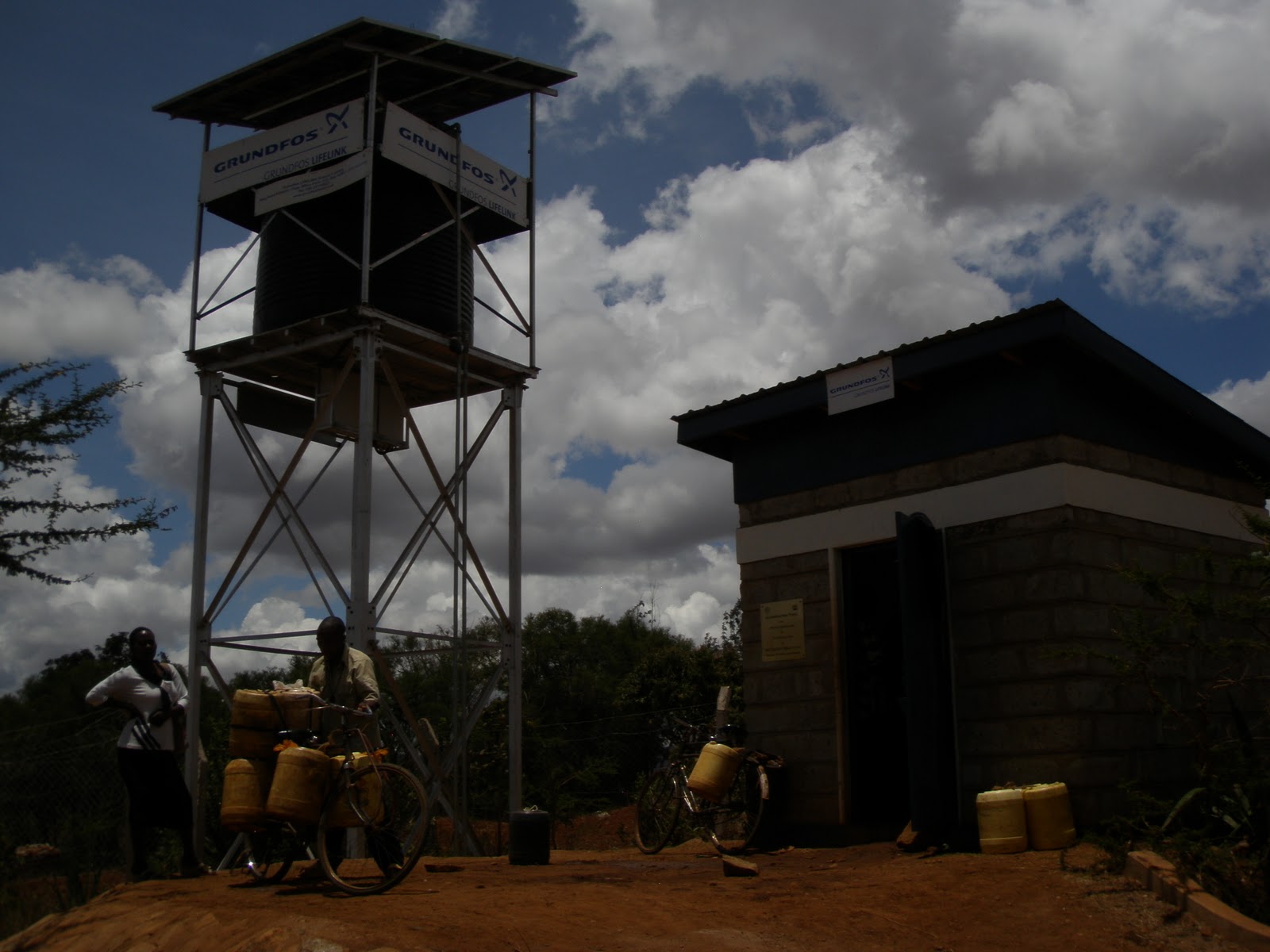
Kathangathini School Committee and user Roda Wambua. The LifeLink project in Kathangathini was initiated and run by a Primary School. The access to water changes lives in so many ways: children can be in school longer because they don’t need to walk far to collect water, family health improves immediately (based on interviews Michael and I made), the system is cheap and easy to use, and the school has started a tree nursery and a greenhouse to grow their own vegetables, which was previously impossible with the dry Kenyan landscape.

Grundfos is an international pump supplier and also owns the new technology we are going to use from next month. These are ‘LifeLink units’. They are a great monitoring device; accountable and sustainable.
Kenya is very dry; a good water source is digging in dry rivers

Users buy water using a water key instead of cash, and every the unit records every purchase. Internet connection enables the WMU office to view every transaction externally. Credits are bought with cash from a water vendor (we’re calling ours ‘Water Agents’ because their job description will include more than water sales), who then transfers credits using their distribution key.  Incorporating this technology with the original project engineering design means no water or cash is unaccounted for, thereby sustaining long-term presence of clean and safe water.
Pump from borehole, to tank, to LL unit
Much of the system design is the same as for WMU. They pump from the water source to a tank, which flows by gravity into the LifeLink unit, to be bought by users with their water keys.
The major system design difference is that Grundfos does not treat the water and their only water source is unused boreholes, e.g. at Mangalete (right). Conversely, WMU’s major function is to treat the water. We use any water source, though the Lake is the primary source with the current project, so long as there is sufficient water quantity.


We are changing our project model to be more business-like. Grundfos is a business; we will be more like a charity-business. The water sales will need to cover all operational costs, but revenue thereafter will be reinvested into the community in the form of a community project. WMU will retain ownership of the system, manage all finances, and the Water Agent is going to be WMU staff. In this way, we will ensure exemplary management, trusted business, and long-term access to the safe water. Though guided by WMU, the community will choose and run the community projects from revenue. We are not giving up the opportunity to empower communities through their own livelihood improvements! Through the Water Agent and the Water Action Group, to be formed after implementation, WMU can provide enduring health and hygiene trainings, discipleship and evangelism. So as much as WMU owns the business, it is the community efforts that determine the real “success” of the project.
We believe this is the way God wants us to uplift fishing communities. To display Kingdom culture by exercising sound business practices that exemplifies integrity, reliability, and the love of Jesus Christ. The local Water Agent and Water Action Group serve as a social and cultural bridge between WMU (keep in mind someone from another tribe can also be counted a foreigner) and the community.
So that is our pilot project for the next year. Pray for us in this endeavour.

Michael (left) talking to users and the vendor at Kola project site
On a personal note, Bryan and I have moved into the double room apartment next to Jude’s house. We will get our furniture in the next couple of days. It’s going to be a nice little home; we are grateful to have somewhere to set up as a place of retreat and hospitality. I must send photos of our home... once it has furniture and isn’t a pile of our stuff. But it is clean now J
As you can see, God is doing a lot of good things. It’s a time of development in so many ways. It reminds me of God’s words in Habakkuk 2:2-3
Write down the revelation
   and make it plain on tablets
   so that a herald may run with it.
For the revelation awaits an appointed time;
   it speaks of the end
   and will not prove false.
Though it linger, wait for it;
   it will certainly come
   and will not delay.
Love and blessings, Emily

Monday, 29 August 2011

Newly wed

Wedding
Other than sending you the link for our wedding photos, this is the first time I’ve written to you since our wedding. Long time! How are you all doing? We had the loveliest wedding, as you may have noticed. The weather was warm, the wedding party was happy and handsome, our guests were so helpful with the preparations, and Uncle David gave us a wonderful Christian marriage talk. It was simple and beautiful, beyond what I’d hoped for. We are so very happy! Thank you kindly for your prayers, messages, gifts and warm wishes. We love you so much.
And to give you a little taste of the day, straight from our Order of Ceremony, our first Bible reading:
Revelation 19:6-8 – reading by David Mohr (audience remains standing)
Then I heard what sounded like a great multitude, like the roar of rushing waters and like loud peals of thunder, shouting:
“Hallelujah! For our Lord God Almighty reigns. Let us rejoice and be glad and give Him glory! For the wedding of the Lamb has come, and his bride has made herself ready. Fine linen, bright and clean, was given her to wear.” (Fine linen stands for the righteous acts of the saints.)
Then the angel said to me, “Write: ‘Blessed are those who are invited to the wedding supper of the Lamb!’ And he added, “These are the true words of God.”
We were further blessed with a 9 day stay in Zanzibar.  I like the Western tradition of holidays. But Uganda is definitely home, and it’s good to be back.
Work
The general idea.
Water Mission International (WMI) has two goals. Their mission is to provide safe water and the message of Jesus Christ to everybody. WMU’s mission is to do the same, but for everybody in Uganda. We have office staff; an engineering team; and a community development team, which includes two part-time pastors.
Top picture: Palms, sea and blue sky in Zanzibar
Below: Star fish as we were walking (all day!) between our accommodations


The basic method to date is:
1.       Community development teams goes and makes an initial assessment by looking at the community lay-out and water sources, and talks to local leaders to gauge their interest and general cooperation in community affairs
2.       Engineers come and see how the Living Water Treatment System (LWTS) can be installed. The LWTS is the filtration and treatment system that pumps water from the Lake and then out to the taps in the community
3.       Community development holds a community meeting to explain the project to the community, potential positioning of the LWTS, and to mobilize community efforts to contribute materials and form a Safe Water Committee (SWC)
4.       The SWC is worked with to mobilize the community in their commitment of materials and labour. This group will be in charge of running the project so that the community has sustained access to safe water
5.       A Memorandum of Understanding is signed by WMU, SWC and local leadership
6.       Once materials are contributed, the engineering team gets to work
7.       Community development holds trainings on health and hygiene, evangelism, and record keeping
8.       Once the project is completed, a celebration is held. This further promotes the project, with messages on safe water and Jesus, and ultimately marks the point where the project is given to the community (though if they don’t look after it the MoU states that WMU can come and take the LWTS)


There are about to be some significant changes made, as WMI is sending WMU some LifeLink systems. These are going to be attached to the LWTS in the place of taps. To start, there will be one at each project site. They operate with (what I shall call here, to simplify) ‘water credit cards’, so that there is less handling of cash and every transaction is recorded. It will be a lot more expensive to start up, but a lot more accountable. Another issue with the current model is that the team doesn’t have time to have a long-term presence in the community. We will employ someone, with the income made from selling water, to run the system, continue health and hygiene trainings with a volunteer team, and do consistent ministry for discipleship.   It is a, again my wording, charity business model. As in, the capital will come from donations, but once implemented all costs need to be covered by the income. 

Great ideas aren’t accepted overnight.
Much as in the Western world, we can ‘know’ something is a better way (in efficiency, morals or priorities) than what we’re doing now is far from ‘doing’ it, so it is in the developing world. Many villagers know that bad water is bad for their health; in fact they face the consequences daily, but they do little about it. I guess it’s a similar idea to our saying, ‘what doesn’t kill you can only make you stronger’.  People are strangely used to living in poor conditions; especially if they’ve been brought up believing that poverty is their fate, and without any encouragement that they have value.  That’s why, as water development workers, we try to make our systems and trainings very accessible and couple the practical aspects with some truths about God.   We are an active testimony that God wants their lives to be more.
Cool rock formations as we emerge onto north-east beaches

Bryan and I as WMU workers.
We’re busy working on the new project idea, writing out lots of manuals and project ideas. However, we are yet to get clarification on our roles. This is not a problem, so long as it happens. The Africa director is currently here being the Uganda director. He might make us Country Program Directors in less than 3 months? However, we would be leading in unison with the development and engineer heads, and our major role would be to raise up a Ugandan director within the next 12-18 months.  Our future with WMU is uncertain, but we are committed for a time.

House hunting
We’re currently staying in my room. The landlord is staying in the guest room in the main house until we move out at the end of next month. We have where we are going to now!
There is a lady called Jude in town, she’s an Aussie. Those of you who have come to Jinja will have met her in her little restaurant, ‘Ozzie’s’. She has a small two-roomed house attached to her house and offered it to Bryan and I for a very good price. Recently, someone who knew her robbed her, so she would like the security of having us around. I would want someone to stay with me too! I have known Jude since 2004 when I worked at St Moses Children’s Home. She has seen me grow up in my role as a missionary since I first came.

Beautiful woodwork on the doors of Stone Town, Zanzibar

Praise reports:
-          That so many friends and family were able to come to our wedding, it was a wonderful occasion and we are so blessed.
-          For all the messages, prayers and gifts that the rest of you sent us.
-          Good weather and safety for our time in Zanzibar, and the fact that we were able to go!
-          My brother requested I pray for his friend, who was having an operation. They were very worried, but he is now fine. Thank God He really cares and is so quick to act when we ask!

Prayer requests:
-          WMU is currently providing safe water to about 25,000 people. Please pray for us as we work out how to best run the new model, so that peoples’ lives can be truly changed.
-          For the making of our home as we move into Jude’s.
-          Our role in WMU.
-          Peace and commitment as we move into our combined calling. We know from the stories of the prophets and disciples in the Bible that what was important was doing as God directed, and being a constant testimony. May we do that with our eyes in the right place.

Right: Aussies!


I wish my family (including the ladies!) could be here still.
Love to you all, Emily Mohr

Wednesday, 23 February 2011

God will as you

Go Uganda!

God will… as you
I must start by giving thanks to God for the peaceful elections. And thank you for joining in prayer and holding faith. In a year of many African elections, and those so far have resulted in intense acts of violence, it would not have surprised anyone if Uganda went down the same track. But they didn’t!
President Museveni is back in for the next 5 years. I believe this is a good thing, and clearly it is what Uganda wanted as he won by a massive percentage.
This evening I got a call from Museveni. Seriously – my phone was called with a message thanking me “Hello, this is the man with that hat, your President Museveni… let us work together for a better Uganda…” and it continued in Ugandan languages. Nice touch Museveni!
On [God] we have set our hope that he will continue to deliver us, as you help us by your prayers.  Then many will give thanks on our behalf for the gracious favour granted us in answer to the prayers of many.
2 Corinthians 1:10a-11

Ps Ronald is translating for Joanna as she preaches the main morning sermon. You can see the coaster in the background – this is used to drive people to church that come from far away. That being said, there is one man who comes from a far off village – maybe 16km – that the coaster doesn’t go to, and he rides his bicycle every week!


Bryan and I spent the weekend of elections in Nawansega. I went up Friday (the Presidential election day), rather than Saturday, just in case there were troubles following elections.  If police were notified of even tensions they would be on location within minutes. Consequently, the place was very quiet most of the time, except for a few celebrations when the local MP was announced. 
Ps Ronald (right) introducing his wife Rachel (centre) at Buwaabe church. Rachel moved to the village, from Kampala (Uganda’s capital city), after they married in January. They are the children’s ministry leaders, including a Saturday program and Sunday mornings.

Please pray for their children’s ministries, the outreach programs they run, and their relationship, especially as Rachel adapts to the new environment.


Saturday nights
ATK has worship night every Saturday. It was Joanna’s week (once in a month) to be in the village again, so she was the one to share a few verses. It was definitely a night of ministering to the children. A lot of people usually get touched by the presence of God on these nights – it’s a time for the Holy Spirit to do His work, which He’s very good at, of comforting, convicting, and bringing revelation of God. This week in particular almost every child was on the ground listening or speaking to God, or simply overwhelmed by His beautiful presence.
The start of worship. Adults seen in pic: Ps Kibet (centre), teacher Steven (left), Margaret (right).
Imagine all those people either praying for others or lying on the floor – that’s what happens.
These children have difficult backgrounds – that’s why they’re in an orphanage – and to see and be part of having their lives touched and their value affirmed is truly awesome. There is a way to go, because healing and transformation takes time (though not always), but seeing the little changes along the way is an encouragement that 1) people do have amazing potential; and 2)this potential is realized when we stay with the One who put in us.

Culture thought: Community stories
Something that is different to my cultural background is the value of stories here. Whether people are preaching, dancing, or discussing between generations, there is a strong emphasis on giving a message through a story. Long stories too.

 Muze (polite term used for an old person) Ezra and Mukyala (‘wife of’ - women are titled in reference to their husband or kids) Ezra from Bukenke. We had nice chats, and they kindly gave me a full fenne (jack fruit) and 2 eggs.

I think there are a number of social reasons for this. Perhaps including (NB these are ideas not a thesis):
-          Africans have time: they take time to talk and listen, that our mode of life doesn’t allow for; plus, it takes so long to get around that what you came to do has to take long enough to make the journey worthwhile.
-          Wisdom and knowledge is learnt through experience, which (traditionally) gives a greater respect for elders.
-          Illiteracy
-          Lack of leisure time options in the village puts conversation and dance at the height of entertainment. I actually really like the messages in local songs, and the bond that comes from participating in the non-electronic or resource based entertainments.
-          Community members are (at least traditionally) strongly bound to one another, whether they like one another or not, because you either stay in the same village your whole life, or marry into a neighbouring one. These village circumstances need shared wisdom for basic survival and to maintain community cohesion.

Unfortunately, the sharing of these knowledges seems to have declined. Part of that is the mobility and changing work conditions that come with modernization – and I can hardly complain against that as the benefits are many, such as health standards and survival rates. On the negative side, wars and diseases such as HIV have attacked the older generations, leaving children without parents. If you’re not parented, it’s likely your own children will not be adequately parented… SO more efforts and options must be provided to teach the current generations.  Education so they can take on modernity in the Ugandan context; morality (based on God, because that’s where correct standards are from) to break the cycle of sin, and its consequences; and community so all can work with and for one another, for the greater benefit.

Coming back from Bukenke, young children were collecting water
Bryan drove them home to save them the hike with heavy jerricans

I believe this generation has the power to change their country IF they are taught.

Coming up…
  1. Next week I am doing a water, sanitation and hygiene (WaSH) seminar at the Source Café in Jinja town. Water Source ministreies is having key people from the different villages they are working in, plus some workers from the Source Café, come to learn different points about WaSH and empowering communities in it. Please pray for the seminar for clear and enjoyable teaching, and that it leaves trainees with tools to go back and impact their communities.
  2. The ATK church in Bukenke is almost finished. I’m excited about this because it provides this very rural community a shelter to have the church services, and to conduct trainings from. It’s at this site that we would like to put in a well… after I’ve done WaSH training, of course.


Celebrate and continue to pray for Uganda!